Signs Your Garage Door Track Is Failing
Why garage door track problems are easy to overlook
A garage door track problem does not always look serious at first. The door may shake a little, scrape near one side, pause in the same spot, or close with one corner sitting slightly lower than the other. Because the door still moves, many homeowners assume the issue can wait.
The track is the guide path for the rollers. It helps the garage door travel up, down, and overhead in a controlled way. When the track bends, shifts, loosens, rusts, or collects debris, the door can no longer move cleanly through that path. That is why early garage door track repair matters. A small alignment issue can put extra pressure on the opener, rollers, hinges, brackets, cables, and door panels. Left alone, the problem can turn into a garage door off track repair, which is usually more urgent and more disruptive.
What does a failing garage door track actually look or sound like?
A failing track usually gives several warning signs before the door stops working completely. Watch for these common clues during normal use.
- Crooked door movement: One side of the door rises or lowers faster than the other.
- Scraping or grinding noises: A harsh metal sound may mean a roller is rubbing against a bent garage door track.
- Visible gaps near the rollers: Rollers should sit properly inside the track, not angle outward or look partly loose.
- Shaking during operation: A door that wobbles, jerks, or vibrates may be struggling to follow the track.
- Sticking in the same place: If the door hesitates at the same spot each time, it may be due to damage. A blockage or a misaligned track can also cause it.
- Loose brackets or bolts: Track hardware should stay tight. Movement around brackets can allow the track to shift.
- Dents, bends, or rust: Physical damage can interrupt the roller path and make the door travel unevenly.
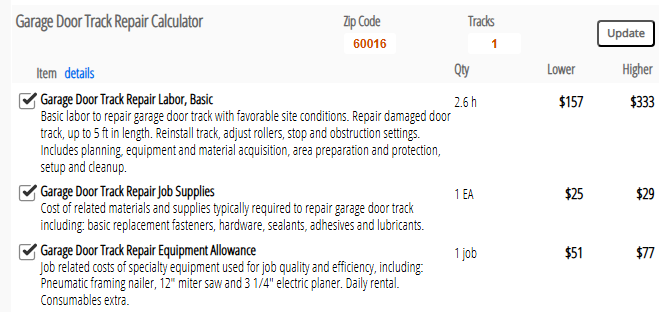
How Much Does a Garage Door Track Repair Cost?
In any case, the cost of repairing a failing garage door track is more or less $300, depending on the severity of the problem. Homewyse gives a rough estimate for a basic repair job in Des Plaines, Illinois.
Why this matters before the door comes off track
A garage door is heavy, and the track helps control that weight while the door is moving. If you force the door through a damaged or uneven path, other system parts absorb stress they were not meant to handle.
The opener may pull harder. Rollers may wear down faster. Hinges may loosen. The door may close unevenly and leave gaps around the opening. In some cases, the door can slip partly out of the track and become unsafe to operate. This is also why repeatedly pressing the opener button is not a good test. If the door is crooked, jammed, or scraping, do not force another cycle. It can bend the track more and raise the risk of more damage.
Which areas of the garage door track should you check first?
If the door sounds rough or moves unevenly, a basic inspection should focus on the parts that guide and support the track system.
- Vertical tracks: These run along both sides of the garage door opening. They should be straight, secure, and evenly spaced.
- Horizontal tracks: These guide the door overhead. Sagging, bending, or loose support brackets can affect the entire movement path.
- Rollers: Worn, cracked, rusted, or stuck rollers can make a track issue worse and cause noisy operation.
- Track brackets: Brackets hold the tracks to the wall and ceiling. Loose brackets can let the door shift out of alignment.
- Debris and buildup: Dirt, leaves, small objects, or hardened grease inside the track can interfere with smooth travel.
- Door balance: If the door feels heavy or uneven when disconnected from the opener, the track may not be the only issue.
A careful garage door maintenance visit should look beyond the visible track. The goal is to find out if the track is the main problem.
Or, to see if another worn part is pushing the door out of alignment.
When is a garage door track problem actually an alignment problem?
Sometimes the track is visibly bent or loose. Other times, the track is only showing symptoms caused by a different issue. A weak spring, damaged cable, worn roller, loose hinge, or opener force setting can all cause the door to move unevenly.
That is why replacing or adjusting only one part does not always solve the problem. If the door is not balanced or aligned correctly, the track may continue to wear in the same spot and the issue may return.
These signs usually point to a bigger garage door alignment repair rather than a simple cleanup:
- The door looks tilted while opening or closing.
- The opener strains, hums, or stops before the door finishes moving.
- The door makes a loud pop, bang, or scraping sound.
- Rollers keep slipping, jumping, or looking uneven in the track.
- The door reverses unexpectedly or refuses to close all the way.
- The track looks normal, but the door still moves roughly or crookedly.
For more safety details, homeowners can review the U.S. Consumer Product Safety Commission’s guidance. It covers garage door opener safety and routine garage door inspections. It explains why you should check garage doors often. It also explains why reverse functions matter. It warns not to ignore springs, hardware, fittings, or door movement.
When should you call A1 Garage Door Repair?
Call A1 Garage Door Repair if your garage door is crooked, noisy, stuck, shaking, or showing visible track damage. A technician can inspect the track, rollers, brackets, hinges, and cables. They can also check opener settings and door alignment. Schedule garage door track repair with A1 Garage Door Repair if the door is scraping, crooked, stuck, shaking, or already off track.
If the door is already off track, do not try to pull it back into place or loosen random hardware. The door may have tension, and it may not support the weight evenly. Simple visual checks are fine. Bent tracks, loose brackets, roller problems, and alignment issues need the right tools. Follow proper safety steps.
Final takeaway
A failing garage door track often starts with small warning signs. These include scraping sounds, crooked movement, shaking, stuck spots, visible bends, or rollers that no longer sit right. Those signs should not be ignored just because the door still opens.
The easiest rule is this: if your garage door no longer moves smoothly in a straight, quiet path, schedule a track inspection. Early garage door track repair from A1 Garage Door Repair can stop small noise issues. It can also prevent a full garage door off track issue that might cost you a hundred dollars more to fix.